
Fishermans Cove Road, Arizona
Less than 48 hours ago, Tom and I were knee-deep in a raging river, scrambling to find a way to save Envy. As the water rose around us, we knew we only had a short window before we’d have to abandon her and get to higher ground. When the second attempt failed and our friends’ truck couldn’t pull us free, we pulled the plug. (How nice it would be if that were only figurative.)
We drove away into the dark and watched the water keep rising around her.
I’ve never been in a natural disaster, and certainly never a flash flood. Back home in B.C., rain is welcomed by the forest. It drips off the branches of giant cedars, playfully bends big ferns, and gets soaked up by an endless mossy floor. Here in Utah and Arizona, the ground doesn’t take it. Waterfalls appear in the blink of an eye, dry riverbeds become a raging force in minutes, and everything they touch gets pulled along with them.
A few hours before it all happened, we were camped near Lake Mead with our Dutch friends Patrick and Orla, playing a game of dice in the late-afternoon sun. The forecast called for a few showers and thunderstorms in the surrounding area, but was nothing compared to the hurricane-like warnings we’d had earlier in the week in Moab. So, we didn’t stress.
In the distance, the clouds darkened, but no rain fell. We watched lightning light up the sky, and the thunder took long enough to reach us that we figured the storm wasn’t close. What we didn’t realize was that the rain falling miles away was building a flood headed straight for us.
We were packed up and ready to go before the first drop hit our hood. We knew we were camped in a sunken river canyon, the last place you want to be in a flood. We weren’t naive. We’d been warned to stay out of canyons, but the forecast hadn’t looked threatening. Not being experienced with flash floods, none of us could have guessed that rain falling far away would come at us that fast, down the exact path of our only way out. We had never seen a flash flood before, and assumed we’d have time to reach higher ground.
We were so very wrong.
As we rounded the first bend heading back up the riverbed, we took in the severity of our situation. A waterfall was already pouring off the top of the cliff above us, and a shallow layer of water covered the ground. The rain all of sudden came down harder, and the water under us started getting deeper.
Tom was driving in low range, second gear. When he tried to shift to first, we bogged down and the engine died. The water had already a number on us, and Envy wouldn’t start again. We radioed Patrick and Orla, and they turned around right away. Patrick’s winch wasn’t working, so we got out our kinetic rope and tried to pull Envy out. But as the water rose, so did the sand, rocks and branches piling up against her, digging her in deeper.
Orla was panicking. Patrick knew we had to go. I resisted for a moment. Then we jumped into the back of their AluCab and they got us out of there. If it weren’t for Patrick and Orla, I don’t know where Tom and I would be. Would we be stranded on the roof of our truck, praying the river went down before it took us with it? Would we be scrambling for higher ground on foot? I don’t know, and I’m choosing not to think about it.
Patrick did an incredible job driving us out of the river. We stopped on a raised bit of road to make a new plan. Only then did we notice we didn’t have shoes on. We’d been in flip-flops all day and had jumped into recovery mode barefoot. Our clothes were soaked from the rescue attempt. And I’d left everything in the truck: passports, wallet, computer.
After I’d changed into Orla’s sweatpants, sweater and shoes, the shock of leaving Envy behind suddenly hit me.
I felt a visceral sadness as if I’d left a friend or a family member stranded and alone. I broke down sobbing, holding onto Tom and repeating, “We left her.” We just left her there.
I know my truck isn’t a person. She’s an object that can be fixed, repaired or replaced. But she’s home. She has carried us thousands of kilometres, over mountains, across deserts and through more than a few tough spots. We took a year to build her out, spending all our saving in the process. We’ve seen some of the most beautiful places on earth because she got us there. She’s pushed us past our comfort zone. She’s made us laugh, cry, face our fears and feel completely, stupidly happy. She’s the reason we get to live out this dream at all. Leaving her in that river felt like leaving part of myself behind. I was heartbroken.
When the shock wore off, I managed a short nap beside Patrick and Orla’s chocolate lab, Lewie, until his snoring woke me. I climbed out of the front seat to stretch my legs. Meanwhile, the guys had been on a mission. The river had already dropped considerably, and they wanted to go back to Envy and assess the damage. Once we all agreed it was safe, we drove back down the same river we’d just escaped. The difference an hour made was staggering. The high water was already gone, and all it had left behind was wet gravel, flattened bushes and rearranged stones of all sizes.
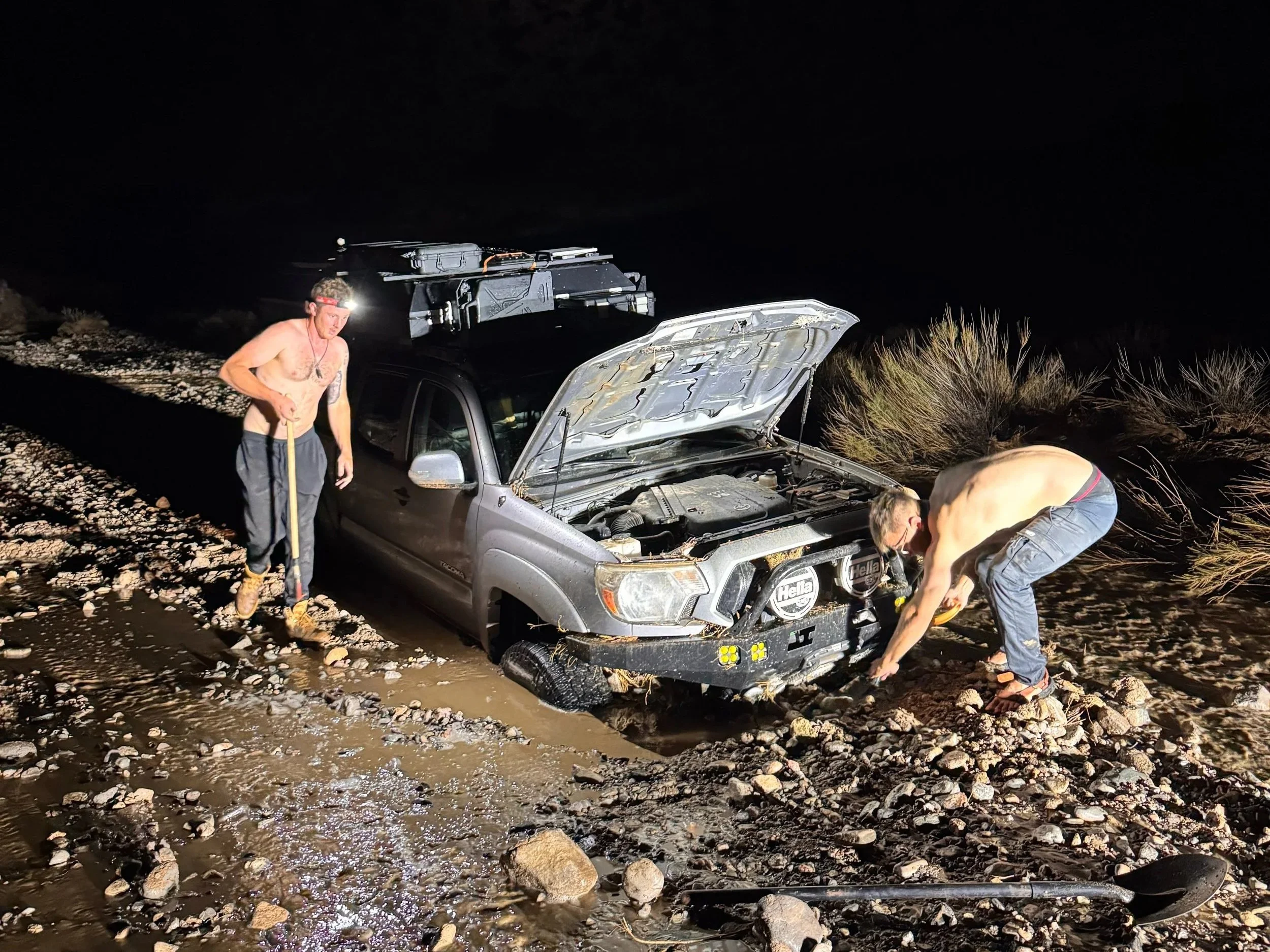
Envy was a sorry sight. She was covered in mud, with sticks and stones jammed into every crack and crevice. Her tires were buried, the front bumper looked like a bale of hay had blown into it, and the mud line reached all the way up to the windshield wipers.
The four of us spent the next four hours digging her out. Tom used our Hi-Lift jack to raise each tire so we could dig out space for our four recovery boards. After a lot of hard work, we winched her free and towed her 20 miles up the riverbed and along the service road to safety. Once we hit pavement, we popped the tents and slept for a couple hours before continuing out to the main road.
A few weeks earlier in Utah, I’d connected with a man named Eric via our Instagram account. He’d kindly shared a few of his favourite trails and camp spots with us, and every one of them was among the prettiest places we’d been. Before sunrise, I messaged Eric to explain what had happened. I asked if he knew a local shop or anyone with a trailer who could pick us up. He wrote back quickly, saying he had a trailer and a shop full of tools at home, and he’d be happy to pick us up, take us there and help us figure out what was wrong.
We couldn’t believe our luck.
We thought back to the two times on this trip that we’ve been the ones doing the recovering. The families of the young men we rescued were so grateful. I always knew our turn would come, and here it was. Like a flash flood, the kindness of strangers can catch you off guard and sweep you off your feet. Someone we’d exchanged only a few messages with was about to go well out of his way for us.
We spent most of the day attempting to clean Envy while we waited for Eric to finish work in Vegas. He arrived around 4 p.m., loaded her onto his trailer, and we drove three to four hours to his hometown of Panguitch. That night, Tom and I lay in his guest bedroom talking about how close we’d come to something much worse, and how lucky we are to have the friends, and connections, we have. Whatever the morning brought, we had each other and we were alive. That was enough.
After a solid sleep and a very long, very hot shower (my first real one in weeks), the guys started pulling things apart. They removed the airbox and the spark plugs and tried turning the crankshaft by hand, but it jammed. When they looked at the pistons, one moved with just a tap of a screwdriver, which suggests a snapped connecting rod. Two of the spark plugs also came out wet. Most of this was gibberish to me, but those of you who know engines will understand. This is not good.
The engine needs to be replaced.
A year of exhausting work, five months on the road, and thousands of kilometres behind us, our world has come to a sudden stop. But it’s not over. We will need to lean on each other, practise some patience, get resourceful and see if we can get Envy running again.
This was a hard learning experience, but we’re grateful for all the support we’ve received so far from the off-road community.
We made a huge mistake, and are now paying for it. But, thankfully, not with our lives.
