
Hunting on Haida
Day: 100
Km travelled: 17,000
After completing our journey north, Tom and I planned to reconvene in Terrace with a couple friends from Pemberton, spending a week together in Haida Gwaii. While running errands beforehand, Tom noticed our battery was running low in the camper. On inspection, and a phone call to Redarc in Australia, we discovered our DC-DC charger had failed, and the warrantied replacement would take a week to reach Terrace.
Thankfully, Haida Gwaii was already booked. We'd be gone for a week regardless, returning to Terrace before continuing south. With our friend's parents' address to fall back on for the delivery, we ordered the part and settled in to wait. For those unfamiliar, as I was until we built the camper: the DC-DC charger manages power from the truck battery to the lithium battery in the camper. Without it, no fridge, no induction cooktop, no Starlink. Everything to do with our camping setup, not the truck itself, runs through this one part.
We manually trickle-charged the battery overnight on the front lawn and set off for Haida Gwaii with the battery a 100%. For the week ahead we'd cook only on the BBQ and go without Starlink (no biggie). Thankfully the fridge only pulls about 10% of the battery per day, so it could stay on the whole time. Easy.
It's a short drive to Prince Rupert from Terrace. We strolled the town, ate dinner at the seaside marina, and boarded our overnight ferry at 10pm. Unlike the ferries on the south coast, this one has you reverse down the gangplank into your spot, so you're facing the right way when it docks. I was glad to hand that job to Tom. It was drizzly, foggy, and, if you can believe it, actually dark, which is something we were unfamiliar with now as we hadn’t seen stars since the end of May.
Spoiled with an overnight cabin, fresh linens, towels, a shower, and a toilet, we collapsed into our bunks just after 10pm and fell asleep to the hum of the ferry engine underneath us. We woke at 5am to humid air and dark skies as the ferry docked in Skidegate, on Graham Island. Excited for our first proper sunrise since leaving Squamish, we drove north out of town and parked at a rocky beach to wait for the sun, tiptoeing over volcanic rock, seaweed underfoot, hermit crabs scattering, warmth creeping over us as the light cleared the clouds on the horizon.
Haida Gwaii
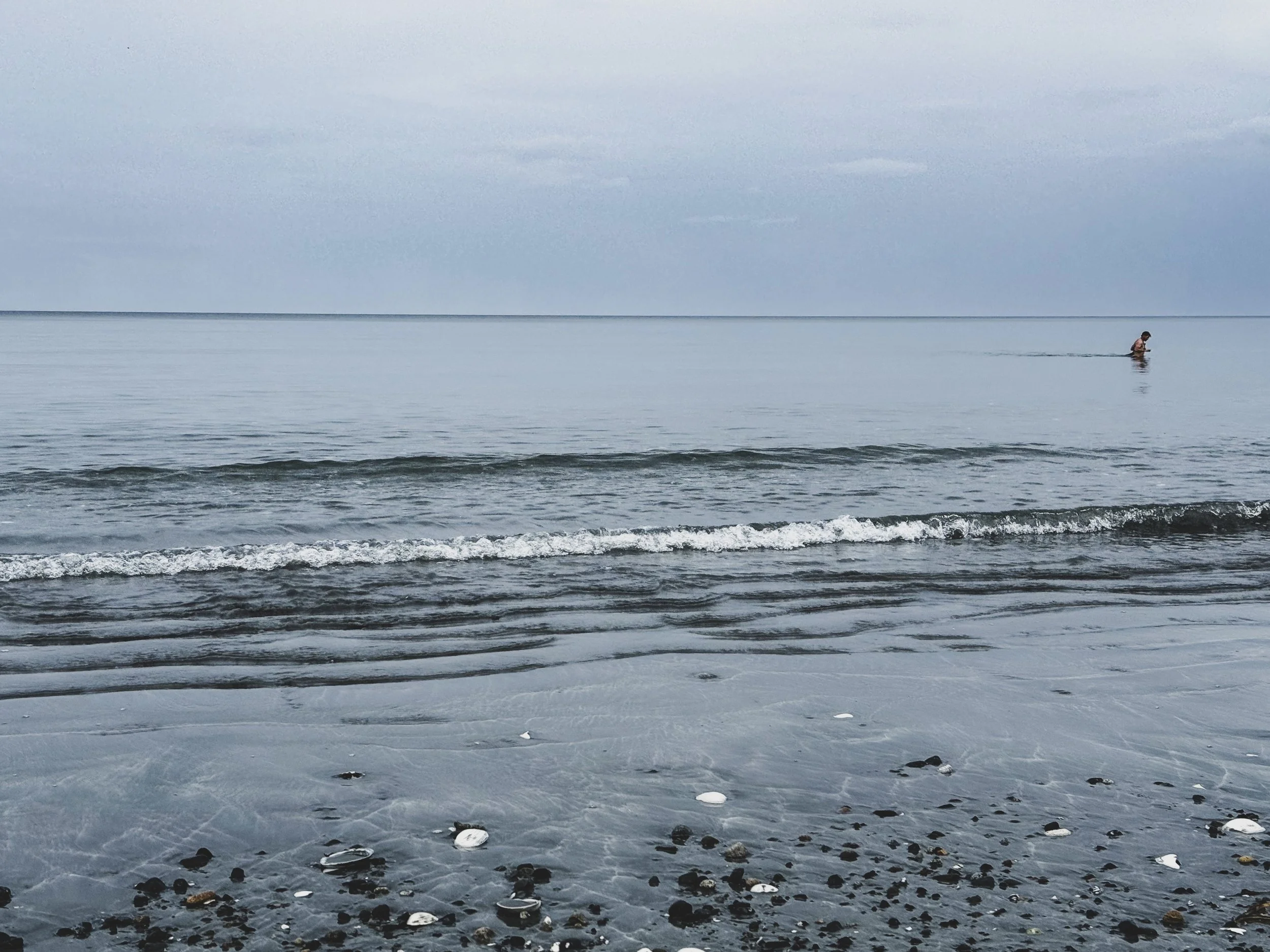
The air smells of salt and pine here. Black volcanic rock meets gold seaweed at the shoreline, painting the edge of this world rust where land gives way to ocean. The Pacific Northwest is so fresh you can feel it: humidity and salt kissing your skin, dampening your hair, cooling your lungs with every breath.
After sipping coffee and watching the world brighten we drove to the north tip of the island and set up at Agate Beach. The northern part of Haida Gwaii gets ravaged by wind. Low fog hugs the beaches, waves crash a few meters off, and there's barely a break between the two. We spent three days exploring Tow Hill and along North and East Beach, driving Envy up the sandy shores, and hunting crab. Every day, Tom waded into the shallows, net in hand, scouring the seabed for our dinner as it scuttled sideways across the bottom. Every day, the crab won. Not one made it back to the pot. Thankfully, we had packed alternative meals.
Everything here is bent and battered, holding on for dear life. The trees and brush tangle together, hugging together on as the ocean presses against them, gritty, thick, and strong. Behind that wall, moss and fern and softer things grow safe, cocooned in the forest, out of the oceans prying hands. The same ocean that feeds the land bleaches the driftwood, carves the rock, and bends the trees. Her love is relentless, not for the faint of heart, like the woman you can't live without, even though her anger alters your atmosphere.
Mist drapes the land like a wall of microscopic droplets, soaking the ends of your hair, laying a cold sheen on your face. Sweaters go damp. Noses run. Salt fills your nostrils and clings to your skin. Sand fills the car. Our towels never dried.
Before heading south we took a short walk through the forest where the Golden Spruce once stood. Giants tower over a forest floor carpeted in green, every piece of it touching the next, perfectly connected. Sunlight filtered down through the canopy, and under the quiet you could hear the birds working: a rat-a-tat-tat, a buzz, a squeak, a small chorus keeping the silence company.
By day three we were ready for sunnier skies and calmer water, and found both on our fourth night at Grey Bay, on the east side of Moresby Island.
Grey Bay is serenity, at its finest. A gently curving beach a kilometre or so long, campsites tucked behind a curtain of trees for sleeps so quiet you wouldn’t know the ocean was just beyond. We rolled in around dinner, the beach already in shadow, the water still holding the last of the sunlight.
We spent the new two days exploring abandoned forest service roads, squeezing our Toyotas through tight bushes, under low lying trees, seeking secret beaches scattered with sea shells and sand dollars. Bonanza was my favourite. Only accessible by walking track, the sand is a golden hue while purple shells dance along the shore with the moving tide.
After a week on the island, our cups were full, though we left knowing we’ll return as there were more offroad tracks to venture and secret beaches to dig our toes into. Not in a rush to get back to Terrace just yet, we camped on a sandbar on the Exstew River for the night.
It happened to be day one hundred on the road.
Fog hugged the river that evening, coating us in dew, the river was just a whisper over the stones, barely visible under the mist.
Now, with a week on Haida Gwaii behind us, and a hundred days on the road behind that, we took the evening to revel in all that we’d accomplished, seen, explored. I felt unexpectedly relaxed and energized in a way that had nothing to do with rest. It might have been all the salt, or simply knowing we’d come this far. No, we’re not the only people doing this, nor have we been on the road as long as others, but to us, 100 feels special.
Will there be 100 more? I hope so.
—-
A note on photos
If you wish to see more images from our trip, please visit the Gallery of this website.
