
Fire inside the ice
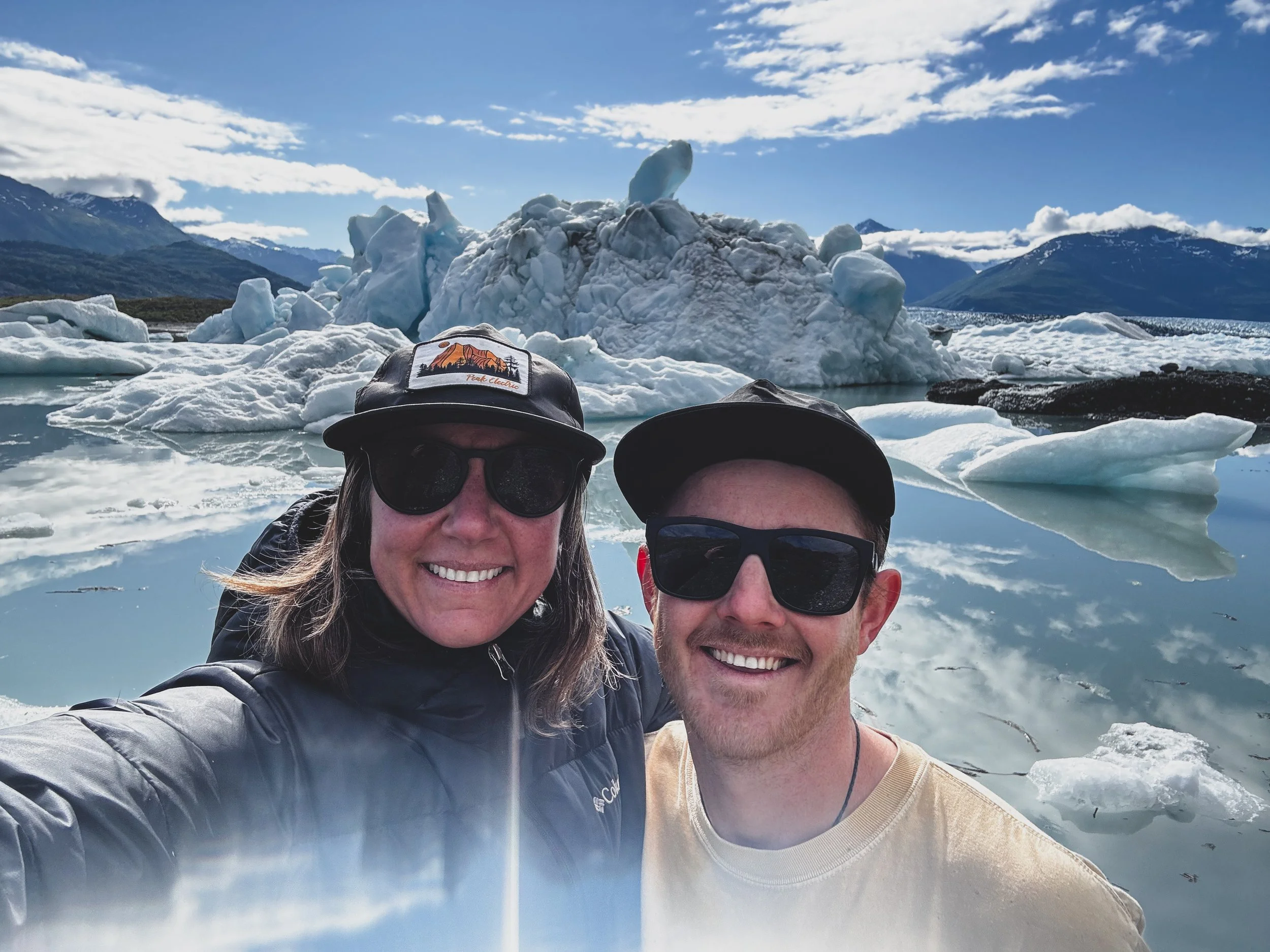
Knik Glacier, Alaska
The beautiful thing about offroading is, much like life itself, you never know what's waiting around the corner. You can't see past the next bend in the road, literally or figuratively. It's one of the things that makes it so exciting, somewhat addicting, and sometimes, a little scary. Offroading demands patience, preparedness, and a healthy appetite for not quite knowing what comes next.
In July 2026, my partner Tom and I were just shy of two months into a six-month road trip through western North America. We'd spent a year planning, custom building our AluCab camper, and mapping a loose route through B.C., Yukon, and Alaska. I discovered Knik Glacier while browsing trails on OnX, and after a few minutes of research, I knew it was one we had to see.
The entrance to Knik is a large gravel parking lot in Butte, Alaska, a few miles south of Palmer. We arrived to find a father and daughter preparing to head out on their quad bike, giving their husky-border collie cross a run in the dry evening air. When I introduced myself and explained what we wanted to do, the father looked at my feet and said, "Have you got waders?" I laughed. My version of waders are yellow and pink Tevas and a pair of shorts. He agreed to take us out a little ways and help us navigate the first river crossing. His daughter giggled when she saw me wade in without hesitation. Tis' the Canadian way.
The trail begins in a birch forest, where locals have carved a series of twisting, winding, choose-your-own-adventure tracks of all shapes and sizes. We had a blast getting wet and dirty immediately: big puddles, soft rolls, and no two paths exactly alike. After crossing Jim Creek, a river that reportedly shifts its sandbars overnight so what's true in the morning may not be true by afternoon, we said goodbye to our guides and pushed on alone.
What followed was a maze of trails clearly designed for ATVs and quads. Envy, our 2014 Tacoma, just barely fit. The dips were big, the mud was deep, and the cottonwoods and birch pressed in close on either side. But the trails were well-worn, and we met no unexpected deadfall.
This is where the learning happened.
Getting stuck the first time was almost fun. A deep dip, soft ground, wheels spinning. Tom coached me through it: rock the truck like a rocking chair, gas forward, release the clutch, let gravity pull you back, repeat. After a few tries, momentum did the work and we popped free. Excellent. Lesson learned.
The second time was less forgiving.
The road opened up and offered three choices. I chose wrong: a deep muddy pool, going too slow to carry us through it. We were in it. Properly. Tom got to work on the recovery gear while I assessed our tree options for the winch. We were, naturally, in the one section of trail with no suitable anchor. There was one skinny birch that might have worked, but before we had the chance to try it, a group of ATV tourers rolled past and one of the guides gave us the tug we needed.
I've come to believe that's how the universe rewards preparedness. You bring the gear, you do the work, and then someone shows up to help anyway. Life’s way of saying “Good job for being ready.”
My Tevas and legs were caked in clay by the time Envy was free, and she looked like she'd been through a hurricane. I've never seen her so filthy. Excellent.
As you push further up the valley, something shifts. The mud thins, the trail widens, and the riverbed of the Knik itself opens up beneath you: a vast, pale expanse of gravel and glacial silt. I imagine this is the terminal moraine of where the glacier reached hundreds of years ago, before it began its long retreat. You drive along it for the final stretch, with no glacier in sight, until you crest a small ridgeline and there she is.
Between you and the foot of the glacier lies a lake filled with icebergs. They range from the size of a car to the size of a house, floating silently, drifting on currents you can't see. Behind them, the face of Knik Glacier spans five miles wide: a jagged wall of diamond-blue teeth, serrated and wild, stretching across your entire field of vision. At 400 feet tall in places, it doesn't look real. Behind it, the ice continues for another 25 miles into the Chugach Mountains, disappearing behind a medial moraine where the glacier forks, and then behind the ridgelines themselves. Mt. Goode rises behind it all, a perfect triangle of snow reaching for the sky.
Tom and I were the only people there.
We made camp on a small overlook above the lake and sat quietly as the sun began its slow Alaskan arc toward the horizon. It doesn't drop fast up here in July. It stretches and lingers. The light moved across the icebergs like a conversation, turning them gold, then amber, then a cold and burning pink. The glacier groaned occasionally, a low crack of ice shifting somewhere deep inside the mass of it, a sound that reminded you this thing is alive and moving, even when it appears utterly still.
Knik, in the Inupiaq language, means fire. Igniq. It's a strange name for a glacier until you sit beside it in the evening light and watch it burn.
The Knik River valley is an offroading playground for all experience levels, with flat riverbed terrain keeping the consequences manageable even when the mud is deep. But what makes it unforgettable isn't the driving. It's what the driving delivers you to. You earn the ending. You get wet, you get stuck, you get unstuck, you get filthy. And then you come around that final corner and the glacier is just there, filling the sky, ancient and enormous.
Patience got us through the mud. Preparedness meant we could laugh when we got stuck. And together, they delivered us somewhere most people will never stand.
It forces you to be present. There's no signal. No noise. Just ice and water and the sound of a world that was here long before us and will be here long after.
This is Alaska at its finest.
